
In the Bower Where Time Stands Still: Muehlenbeckia complexa
- elainahanzel
- Apr 6
- 3 min read
Frothing upward in great misshapen swells, Muehlenbeckia complexa both subjugates and supports, weaving seemingly disparate biological processes and relationships in dyamic native ecosystems.

This native semi-deciduous vine is composed of fresh-green leaves with entire or slightly lobed margins that produce rounded, vaguely chordate shapes. Petiolate, they emerge from slender burnt umber stems in a sparse alternate arrangement.
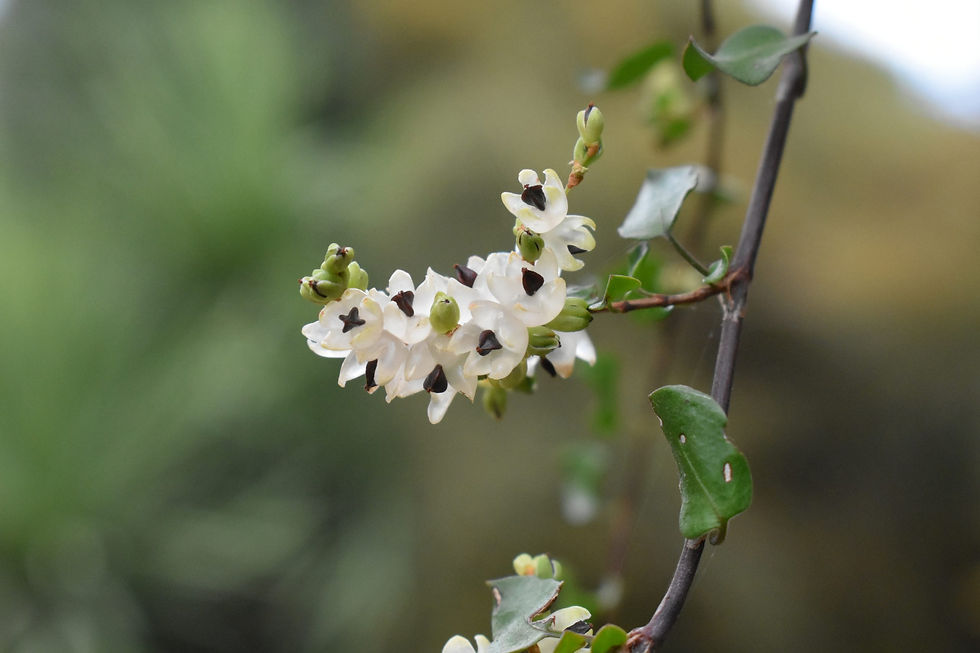
From late spring through early summer, the plant produces small, but charming viridescent white flowers. Dioecious, having staminate (m) and pistillate (f) flowers on separate individuals, plants of both sexes are required for seed production and are typically pollinated by native insects, birds, geckos, and skinks.
The resultant fruit develops only on female plants and appears as an open cup-like form of swollen translucent white flesh bearing a small seed. The succulent outer form is composed of tepals (an undifferentiated petal or sepal in the outer whorl of a flower), which proffer an exposed hard black trigonous nut at their centre. The seed is attractive to birds and lizards and, traditionally, children as was noted by English botanist William Colenso in 1868.
Undiscerning, M. complexa inhabits coastal areas (from dunes to cliffs), forest margins, and open scrubland up to moderate altitudes through both New Zealand islands, but is more abundant east of the Southern Alps in the South Island, Te Waipounamu. Its habitat range is demonstrative of species adaptation and indicative of a preference for good drainage and air circulation as well as full to partial light. Its ensuing habit is reflective of the relevant exposure to those differing environmental conditions.
While young pōhuehue appears prostrate and trailing, similar to the reserved ground cover Muehlenbeckia axillaris, inherent vigor encourages an erratic pursuit of light among the canopy trees. A liane with no distinct trunk or thickening branches, its fine tresses braid together in heaving masses, climbing upon itself or creeping and twining over other plants, often overwhelming shrubs and small trees up to 6m. In forest communities, it provides nesting and shelter for birds and other biota as it ascends more dominant tree species. In coastal environments, remonstrated by shore winds, pōhuehue submits in dense cushion-like mounds. Its prolific habit, even tempered, cultivates interesting organic forms and endears itself toward a sculptural approach in gardens.
Muehlenbeckia complexa exhibiting vigorous habit | Tainui and Tauroa Reserves, Hawke's Bay | Photos by E. Hanzel
Muehlenbeckia complexa is integral in ecological restoration and facilitating biodiversity, functionally stabilising disturbed ground, as occurs on forest edges and sand dunes, and suppressing the growth of invasive species, acting as a nurse crop. The buds, leaves, and fruit are a food source for native birds such as tūī, bellbird, and kererū, as well as geckos. Its distinctive dense growth also offers shelter for insects and other native reptilia. Importantly, Muehlenbeckia complexa is a critical host plant for native lepidopteran species, including the winter copper, glade copper, Rauparaha’s copper, and coastal copper (Lycaena salustius) butterflies.

The endemic L. salustius maintains an intimate relationship with Muehlenbeckia complexa over its entire life cycle. Females lay their eggs individually on the underside of Muehlenbeckia leaves. The emerging larvae live another 6 weeks, exclusively consuming the leaves and occasionally flowers in November and December until pupation, often occurring in the leaf litter under the wire vine. Adults are plentiful but have short life spans no longer than 10-14 days and remain relatively close to their host plants, feeding from the flowers and other native and introduced blooms.
The rapid and unrestrained quality of Muehlenbeckia's growth seems incongruous with the gentle bower it provides the copper butterfly, but it is that very trait that nurtures protection. In even greater contrast, in every brood while some butterflies grow expectedly toward maturity in weeks, others stop feeding after their first moult (of 4 instars) and enter diapause, a period of suspended development, for several months before resuming growth. This is an adaptive strategy Lycaena evolved to survive New Zealand's often unpredictable climate.


