
The Pōhutukawa tree, an emblem of quiet resilience and generosity
- Heda Landscape Design Ltd.

- Mar 6, 2025
- 3 min read

Its name is derived from the term 'hutukawa,' referring to a headdress adorned with red feathers, and 'po,' which holds various meanings, including references to the night or the underworld. The Māori people traditionally planted Pōhutukawa trees to commemorate the burial sites of chiefs, battle locations where warriors perished, or the birthplace of a chief's son. They utilized the bark's juice for its anti-inflammatory properties and as a treatment for conditions such as diarrhoea, dysentery, gangrene, and thrush. Chewing the bark served as an anaesthetic for alleviating sore gums and toothaches, while sucking on its nectar was a remedy for a sore throat.
The Pōhutukawa (Metrosideros excelsa) is a member of the myrtle family (Myrtaceae), which comprises approximately 3,000 species of tropical and warm temperate trees, shrubs, and vines.
Exceptionally well-suited to its natural habitat. The tree's canopy, more horizontal than vertical, distributes weight through its root-laden branches to withstand severe storms. Minute seeds can infiltrate even the smallest crevices, while its leaves are equipped with soft hairs to reduce water loss. Remarkably adapted for colonizing barren lava, the pōhutukawa's branches develop extensive clusters of aerial roots that, upon contacting the ground, secure themselves in typically unstable rock. These trees can live for up to 1,000 years.

This coastal tree serves a significant ecological role by offering a habitat that supports the growth of other colonising plants, it provides nourishment, shelter, and support to an impressive array of animals, and insects too.
Honeyeaters such as tūi, bellbirds, and stitchbirds (which are now absent from the mainland) thrive on the tree's slightly salty nectar, as do pekapeka, our native short-tailed bats. Geckos are attracted to the newly opened flowers and contribute to pollination in a minor capacity. Shags and white-faced herons find refuge and nesting sites in the canopies, while bats inhabit split branches and crevices. Saddlebacks nest within trunk cavities, and the tree's flaky bark supports a diverse array of insects and spiders. Weevils, beetles, flies, moths, and scale insects consume the foliage, bark, fruit, and the twig and leaf litter surrounding the trunk. Just above the strand line (the extreme high water mark), resilient snails persist in the decaying litter.

If you have ever been curious about the cause of the small holes in the leaves of a Pōhutukawa tree, the most probable culprit is the Pōhutukawa leaf miner, Neomycta rubida.
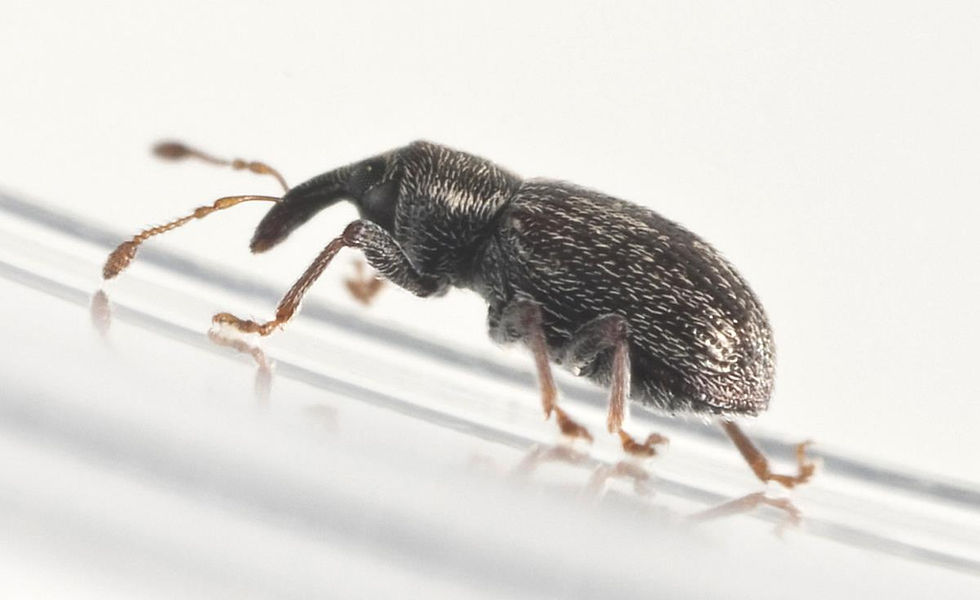
This endemic weevil is found in the North and South Islands of New Zealand, where its primary host plants are located. Adult weevils feed on young leaves, while the larvae create tunnels within the leaves. Female weevils begin laying eggs when new leaves emerge, depositing a single egg into the blade of a young leaf. Upon hatching, the larva tunnels into the leaf, forming a serpentine mine.

Damage to the young leaves of Pōhutukawa and northern rātā by the weevil has occasionally raised concerns; however, this does not appear to have any long-term impact on the health of the trees.
This gentle giant from the plant kingdom coexists harmoniously with the smallest creatures within its verdant protective embrace.
Source: pohutukawa TREE OF AOTEAROA (Bercusson,L. & Torrance, J. 1998, Tandem Press, New Zealand), http://www.landcareresearch.co.nz an authoritative website of Landcare Research New Zealand


